Showing posts with label films. Show all posts

Saturday, 20 December 2014

MODERN SCI-FI FILMS FAQ by Tom DeMichael

Another book in the FAQ series addresses one of my favourite subjects, science fiction movies. Considering I work on the Sci Fi Freak Site, that shouldn't come as any great surprise to anyone.

Also not coming as a surprise to anyone will be the reservations I have over the title and subtitle. There are still no frequently asked questions in this book and I still don't know what they mean by 'all that's left to know about...', in this case time travel, alien, robot and out-of-this-world movies since 1970.

With this book, though, I also have larger reservations about the content than the previous entries I've tried (Doctor Who and Stephen King Films). It's not that it's hard to read; the writer's style is clean and easy to read and doesn't distract from the content at all. It's the construction that I don't understand.

Each film starts with a synopsis and then has some afterwords, analysis, box office and anecdotes. Nothing wrong with that, but it's the amount of room devoted to each that confuses. Take the entry for INCEPTION for example - the plot synopsis runs to seven pages whilst the rest runs to two. That seems to me to be entirely the wrong way around. Admittedly, INCEPTION is a film with a dense and twisting plot, but does anyone really need every twist and turn to be laid out for them? And that's the problem. If you've seen (and loved in most cases) the films then you'll know them well enough to not need to read a detailed synopsis of what happens. If you're going to see the film then you're not going to want to know all the twists and plot spoilers that are included. I found myself skipping the synopses altogether and reading only the 'afterwords'. Since these are the smaller sections and seemingly obsessed with box office receipts and not a lot else, the 380 page count gets a lot, lot less.

More interesting are the opening section on the literary roots of the genre (i.e. some important sci fi writers whose work has been recently adapted), science fiction movie spaceships and notable sci fi movie personages. Since these are not simply regurgitating plots, they have more interest.

It's hard to know who this book can be aimed that who won't be disappointed by it, and that's a big problem.

Sunday, 3 August 2014

THE ZOMBIE FILM from White Zombie to World War Z by Alain Silver & James Ursini

Now that the whole sparkly-vampires-make-good-boyfriends farrago is come to an end and the werewolves-also-make good-boyfriends phase never managed to get off the ground, attention has turned to the zombie as the paranormal boogeyman of choice. Zombies have often featured in low-budget movies, but now the budgets aren't always so low and screens both large and small are awash with the shambling dead.

To cover this increasingly huge genre of work comes this large format book that starts with the generally accepted first zombie movie, White Zombie (having already covered the myth and written words history of the undead) and takes the reader through all the various iterations of the zombie whether it be George A Romero's shambling metaphors for modern society, Stephen King's reanimated pets in a sematary, raging speedsters appearing 28 Days Later or (oh the horror, the horror) zombie strippers.

The early parts of the book are the more interesting as the formative years are covered with appearances by masters of horror Bela Lugosi and Boris Karloff in films that set the earlier, voodoo-linked stories. That moves on nicely into the George A Romero period of increasing gore and social commentary. When it moves into the more modern era, it becomes less sure of itself, often becoming overwhelmed by the sheer amount of output that there is to cover and becoming often a list of films and what happens in them rather than analysis into the thematic and historical contexts. Of course, that might just be because there are no themes being examined any longer. The writing style is generally clean and accessible and entertaining, certainly in the book's earlier sections.

It is surprising, however, that THE WALKING DEAD television series gets so little coverage, considering how influential it has been in the genre.

There is a huge filmography at the end so that you can make sure that you have caught up with all of the more obscure offerings that the genre has and the book also has interviews with zombie filmmakers and contributors that vary from the interesting to the intrusive. For sheer coverage, the book also cannot be faulted as it covers the most obvious entries in the genre to some of the less obvious. It's concentration on the contribution made by Richard Matheson's I Am Legend is refreshingly insightful.

The content of the written words might be variable, but there is no faulting the visuals. The books comes stuffed full of lobby cards, stills and images of corpses in various stages of decay. As you can see from the cover image, this is probably not a book to leave where your four year old can get their hands on it and give themselves nightmares.

THE ZOMBIE FILM from White Zombie to World War Z might not be the ultimate guide to the zombie genre, but it will certainly fill the hole whilst we wait for that that one to come along.


Wednesday, 9 July 2014

STEPHEN KING FILMS FAQ by Scott Von Doviak

Stephen King is one of the great storytellers of our age, hell of any age if it comes to that. It is therefore a strange thing that movie and TV adaptations of his books more often than not fall well short of, well, not sucking.

This book is a comprehensive look at all things screen when it comes to taking the printed words and, more often than not, ignoring the hell out of them. Every production you can think of (and a whole bunch you couldn't and will wish you hadn't found out about) can be found inside the covers here.

First of all, let's deal with the title. STEPHEN KING FILMS FAQ suggests a certain format, but it's not like that at all. There are no list of questions being answered, frequently asked or otherwise. And then there is the matter of the subtitle 'All that's left to know about the king of horror on film'. Well, that forgets about the whole chunks devoted to videotape productions and I'm curious to know what it means by 'all that's left to know'. All that's left to know after what?

Let's deal with the good stuff first. Scott Van Doviak knows his Stephen King adaptations. What it may lack in surgical detail it makes up for in the sheer breadth of its scope. Whilst books could be written (and have been) about the troubled making of Kubrick's THE SHINING, it gets a single chapter before we head on to the next one. There is so much ground to cover that we don't get to dig too deeply at any point.

Von Doviak's tone is light and pleasant and the book itself is a very easy read, almost a page turner. It's very easy to settle down to a quick sample and find that three or four chapters have gone past. The layout is clear, going through celluloid examples chronologically before then moving onto the televisual delights on offer. It starts to run out of steam toward the end, however, but that's because we're on to the odds and sods such as THE SIMPSONS pastiches and films inspired by Stephen King.

Curiously, Von Doviak doesn't really seem to like many of the films and shows on offer. He certainly spends more time waxing rhapsodic about what's wrong with each of them than what's great. Then again, we all do that.

Despite the fact that it's 'all that's left to know', I doubt that there is that much in there that the King devotee didn't already know. The more obscure outings might be useful for the King completist, however. For the person just getting into the visualisation of Stephen King's books, however, there is a wealth of stuff to choose from. Is THE STAND miniseries as good as the book? How did THE SHAWSHANK REDEMPTION move from a short story to a long masterpiece? Is the Stephen King scripted THE SHINING better than the Kubrick version?

It's all here.

As someone who's liked and hated his fair share of King's books and films, but is far from being an expert, I found this an enjoyable, easy read, though I was possibly not all that more well-informed at the end of it.

Tuesday, 1 October 2013

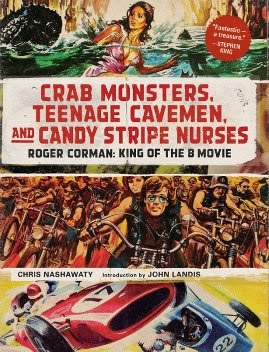
Crab Monsters, Teenage Cavemen and Candy Stripe Nurses - Roger Corman: King of the B Movie

Now that's a title and a half for a book.

But that's fair enough because it's a lovely book, both to look at and to read. It's lavishly illustrated with movie stills, film posters and behind the scenes photographs, all illustrating the story of a quite remarkable man.

In case you don't know, Roger Corman is a hugely prolific film-maker who produced enough films to make him practically a studio. He's the man who shot THE LITTLE SHOP OF HORRORS in two days, but also made my favourite THE MASQUE OF THE RED DEATH, which is just a gorgeous film.

This is not a critical biography of the man, though. The story is told in interview snippets from so many people that worked with (and for, let's be honest) Roger Corman and other movie luminaries. John Landis, Jack Nicholson, Joe Dante, Jonathan Demme, James Cameron and many more all put in their penny's worth.

And pennies seems to have been Corman's ethos. Pay as little as you can get away with and make a profit on everything that you put out. Some of the films were outright exploitative rubbish, but others were bona fide masterpieces.

If only through the people whose careers he helped to kickstart, Roger Corman has been a huge influence on the movie industry and this bright, cheerful and fun read seems just the right way to celebrate him.

100 Science Fiction Films from the BFI

When it comes to movies, the British Film Institute knows a thing or two, so when they choose to produce a book giving you the top 100 entries into a genre then you'd expect to sit up and take notice.

As a result of those expectations, 100 Science Fiction Films by Barry Keith Grant is something of a puzzle.

Now, don't get me wrong - the author knows his science fiction films. Whilst all the usual suspects are there (Metropolis, Blade Runner, Star Wars) there are a few less obvious entries. Nobody could argue with La Jetee, for example, but it's a bit on less well-known side as are Born In Flames and Tribulation 99: Alien Anomalies Under America (what do you mean, everyone has heard of that one?).

No, the reason for puzzlement is the form of the book. Nobody would expect a book from the BFI to be a vapid picture gallery, but the assessment that goes with each film proves to be mainly a precis of the storyline (and yes, spoilers ahoy!) with only a small amount of time spent on why the film is notable. Each film only gets two pages and that's reduced to only a page and a half when you take into account the single image that goes with it. This really doesn't give enough space for the author to go into any great depth.

So, here's the rub - who is this book for? True, if you are a newcomer taking on the genre for the first time, then this might be the book to guide you on your way, but there are plenty of 'best of' lists online. For the the experienced sci-fi moviegoer, there really isn't enough here to make it even a worthwhile gift from a loved one.