Showing posts with label review. Show all posts

Saturday, 12 January 2019

BLOWING THE BLOODY DOORS OFF and other lessons in life by Michael Caine

Blowing the Bloody Doors Off by Michael Caine
The man himself
Michael Caine dragged himself up from almost cliched humble beginnings to become an oscar winning, restaurant owning national treasure, not to mention Batman's butler. His decades in the business have had highs and lows and a longevity that means what he has to say about the movie business (and by extension all business) ought to be worth listening to as he presents the lessons that he has learned in his life and times.

Those lessons turn out to be 'show up on time', 'know your lines', 'grab your opportunities', 'be kind' and 'be lucky' (plus a few others that I don't recall). Considering that I summed those up in a single line and don't even recall the others after a few hours suggest that they weren't really that much to hang a book on all by themselves. Certainly, quite a few of them got repeated several times.

That said, Mr Caine knows how to tell a story and be thoroughly entertaining whilst doing so. He also knows that a film star's autobiography (even a sort of autobiography like this) works best when it is filled with anecdotes about other film stars and Michael Caine seems to have met them all. He kicks of with a story about John Wayne and never looks back.

Michael Caine seems like an all-round good bloke, both from the stories that he tells and the tone in which he tells them. He seems to have maintained a sense of himself and his past despite the heights to which he has risen. He would certainly be someone to have in your list of fantasy dinner party guests. The time that you spend with him in this book may not profoundly change your life, or even tell you much that you don't already know about how to live it, but it will be time well spent as the book is as engaging and entertaining as the man seems to be and that should be enough for everyone.

Sunday, 6 January 2019

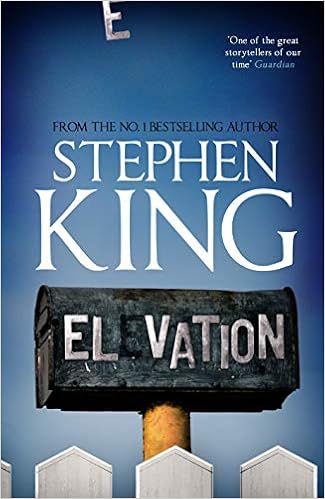
ELEVATION by Stephen King

elevation by stephen kingWe have reached the point where anything that Stephen King writes will be published. I generally don't have a problem with that, but this 'novella' is a thin tome with what looks suspiciously like double spacing. If it took me two hours to read then I'm surprised.

It also felt like some reheated old ideas thrown together. The central conceit of Thinner was a man who got thinner no matter what he did. The central conceit here is that a man is getting lighter no matter what he does. Gravity is losing its hold. Does this cause anyone great concern? No not really.

The main concern is that there's a married lesbian couple running a restaurant and people don't approve. The local seasonal running race should take care of that. Really? In Trump's America, one photograph is all it takes to change conservative views?

It is a slight tale that doesn't last long or think deep, both of which are surprising for King.

That said, the man does know how to write and you breeze through it pleasurably enough, though by the end of the this snack you're left far from satisfied.

Sunday, 25 March 2018

BUFFY THE VAMPIRE SLAYER FAQ


We've been a bit sniffy in the past about the FAQ books because they don't answer frequently asked questions and they don't address the subtitle of "everything that's left to know" about their subjects, but it's time to just accept that this is the marketing line and nothing is going to change that.

So here it is, the latest potted history of Buffy the Vampire Slayer, one of television's finest fantasy shows, with chapters on the major characters, each season's plots, the 'big bads', the spin off show ANGEL and more. 

It's written by people who clearly know the show and clearly love the show and contains interviews new and old, but it is not (as has been the case with the other books in the series that we have seen) revelatory. There is little here that the hardcore fan won't already know and the there is too much here for anyone who is going into the show for the first time. There are spoilers indeed here.

That said, the book succeeds in its primary function, which is to remind you just how wonderful BUFFY VAMPIRE SLAYER was and, after reading it, you'll be bringing down those DVDs and plunging back into the world of the Slayerettes once again.

Saturday, 20 December 2014

MODERN SCI-FI FILMS FAQ by Tom DeMichael

Another book in the FAQ series addresses one of my favourite subjects, science fiction movies. Considering I work on the Sci Fi Freak Site, that shouldn't come as any great surprise to anyone.

Also not coming as a surprise to anyone will be the reservations I have over the title and subtitle. There are still no frequently asked questions in this book and I still don't know what they mean by 'all that's left to know about...', in this case time travel, alien, robot and out-of-this-world movies since 1970.

With this book, though, I also have larger reservations about the content than the previous entries I've tried (Doctor Who and Stephen King Films). It's not that it's hard to read; the writer's style is clean and easy to read and doesn't distract from the content at all. It's the construction that I don't understand.

Each film starts with a synopsis and then has some afterwords, analysis, box office and anecdotes. Nothing wrong with that, but it's the amount of room devoted to each that confuses. Take the entry for INCEPTION for example - the plot synopsis runs to seven pages whilst the rest runs to two. That seems to me to be entirely the wrong way around. Admittedly, INCEPTION is a film with a dense and twisting plot, but does anyone really need every twist and turn to be laid out for them? And that's the problem. If you've seen (and loved in most cases) the films then you'll know them well enough to not need to read a detailed synopsis of what happens. If you're going to see the film then you're not going to want to know all the twists and plot spoilers that are included. I found myself skipping the synopses altogether and reading only the 'afterwords'. Since these are the smaller sections and seemingly obsessed with box office receipts and not a lot else, the 380 page count gets a lot, lot less.

More interesting are the opening section on the literary roots of the genre (i.e. some important sci fi writers whose work has been recently adapted), science fiction movie spaceships and notable sci fi movie personages. Since these are not simply regurgitating plots, they have more interest.

It's hard to know who this book can be aimed that who won't be disappointed by it, and that's a big problem.

Sunday, 7 December 2014

BATTLESTAR GALACTICA VAULT by Paul Ruditis

BATTLESTAR GALACTICA is one of the most lauded television shows of recent years. Notice that we left out the qualifier 'science fiction' in that? That's because the redefined version of a camp 70's STAR WARS wannabe was a genuine phenomenon that crossed the critical divide from genre into the mainstream. That might not be such a big thing nowadays with the success of the likes of GAME OF THRONES and other HBO shows, but it was big at the time.

So, if you were one of the people who loved the show (and if not, why not?) then you could do a lot worse than getting your hands on this lavishly illustrated book that starts with that camp 70's wannabe and goes right through to the doomed spin-off CAPRICA and the tv movies that tried to extend the magic.

There's only a couple of hours' reading time here and the devoted fan won't learn a lot that they didn't already know, but the words aren't what books like this are all about. The production art and set designs are crammed onto every page and there's more than enough to satisfy even the most hardened Galactica buff. And just in case you weren't convinced that this is all about the images, there are a couple of envelopes inside the front and back cover stuffed with pull out images like Ralph McQuarrie's poster, comparisons of ships of the fleet and the development of the cylon warrior.

The design of the book and the gatefold cover make the £20 cover price seem like a bargain. It's coming up to Christmas, so if you have a frakkin' Galactica fan in your life your present problems could just have been solved.

Wednesday, 1 October 2014

SCI-FI CHRONICLES - Aurum Press - Out October 2nd.

It's not often that I open something that I've been sent to review and let out very unmanly fanboy squeals, but that is exactly what happened when I opened the packaging on SCI-FI CHRONICLES. My very first impression was 'Oh my God, it's beautiful'. The cover is a lush patterned black with a rendering of Hal 9000's eye lens and some very shiny lettering that just isn't done justice by the image alongside.

But, the beauty of this book doesn't just stop at the cover. It is lavishly illustrated throughout with glorious colour images. They're not huge, but there are so many of them. Each entry is illustrated with small icon images with some of the larger subjects getting two or four pages devoted purely to the pictures.

You need a lot of pages to get all of that onto and SCI-FI CHRONICLES has more than 570 of them (though admittedly 40 of those are dedicated to the index and the credits).

With so much information now readily available on our electronic devices at the swipe of a finger, encyclopedias like this one are much harder to come by, so it's to Aurum's credit that they are willing to even produce the book, let alone do such a good job on it. There are 27 listed contributors, all of whom seem to have a passion for the subject.

And it's a wide-ranging subject too, since the book doesn't restrict itself to just one medium. There are landmark books, films, TV shows, comics, video games and even characters and personalities all contained within. Isaac Asimov shares space with The Day The Earth Stood Still and Jack Kirby. Steven Spielberg jostles elbows with King Kong and Halo. Even with half a thousand pages, it can't be all-encompassing, but I've yet to come up with one entry that I thought ought to be featured that wasn't. The detail is more of a sketch, an introduction to each subject, but you'll know whether you're interested in finding out more about each by the time that you reach the end of the page.

It's not perfect, though, surely? Very nearly. The chronological structure makes it a little harder than necessary to find your subject of choice if you're not interested in reading it as a narrative and the index is a touch fiddly to find the main article of choice. The chronology also stops in 2009, which suggests that there has not been one single book, film, video game, graphic novel, character or creator who has emerged in the genre in the past five years. That seems a little hard to believe.

The space devoted to each entry can be a little obscure as well. Blade Runner, visually the second most influential film of all time, shares its page with the book Do Androids Dream Of Electric Sheep and mention isn't even given to the excellent video game version and the not quite so excellent KW Jeter sequels. This means that the most influential movie in the genre since Metropolis actually gets less page space that soggy submarine series Seaquest DSV!

Also, any book that states as fact that Tom Baker was the third Doctor has to lose some credibility points.

All of which is nit-picking. The fact is that I have lost hours to this book already and I've had it for less than two days. It has become my favoured reference book of choice and has pride of place on my shelves. That is seriously not bad going.

The £25 price tag might seem a little steep, but take a look inside and you'll probably fall as instantly in love as I did. Also, it's a book that you will go back to time and time again. And it's the kind of gift that your science-loving significant other would thank you for and mean it.

The lovely folks at Aurum have promised one lucky winner a copy of this book absolutely free, so trot on over to www.scififreaksite.com and take part in the giveaway there.

Monday, 22 September 2014

DOCTOR WHO FAQ - All That's Left To Know About The Most Famous Time Lord In the Universe by Dave Thompson

It may have escaped your attention, but the BBC TV series DOCTOR WHO celebrated its fiftieth birthday recently. This was as good a reason for a few million more words to be written about what must be one the most written about television series of all time. What, indeed, can there be left to know?

Quibbles first - title and subtitle. This is not a book of frequently asked questions. And as for its claim that it contains 'all that's left to know' about the Doctor, well that's just nonsense. 'All that's left to know' after what?

Don't get me wrong, author Dave Thompson knows his stuff and certainly has opinions on his stuff, but there is very little here that even a semi-knowledgeable viewer like me didn't already know, or certainly couldn't have found out pretty quickly on the internet. True enough, the chapters on the Big Finish audio productions and the music inspired by Doctor Who were news to me, but then I did say that I was only semi-knowledgeable.

What this book really is, is a comprehensive overview of the show for someone who knows a little and wants to know a lot  more. This is for people who are new to the series in its modern incarnation and want to be indoctrinated in the history.

It is also, make no bones about it, for Americans. The opening chapter is entitled 'The TARDIS in America'.

It is also out of date, containing nothing of the fiftieth year's celebrations, but that's a minor point since any book like this is out of date as soon as it's printed (if it's lucky).

So, what's good about it? Well, if you don't already have an overview of the show then you could certainly do worse than this and it does cover those Big Finish audio productions and books and music as well. There's a comprehensive listing of TV episodes, audio productions, original books and even comic books featuring the 'most famous time lord in the universe'.

It's also pretty easy to read. Thompson has a clean style and isn't shy about coming forward with what he thinks. That he didn't like Adric or Mel is no surprise to any right-thinking individual, but his views on the Moffat era might not go down so well with some others.

There's an eclectic mix of illustrations (black and white) to break up the text and at 258 pages of history and opinions, there ought to be something for everyone to find of interest.

We're back, though, to that thorny question of who exactly this book is for. Completists will want it for, well, completeness, but there's very little in it to make it indispensable. Then again, after so much has been written about the show, what on earth could there be left to know?

Sunday, 10 August 2014

JOSS WHEDON - Geek King Of The Universe by Amy Pascale


Anyone who knows me knows that I love Joss Whedon and will watch anything that he is involved in (even if that is AGENTS OF SHIELD), but before you start worrying, this is not another long-winded speech about my love for the Geek King of the Universe that is Joss Whedon. Someone else has already got there.

Sort of.

For those who don't know Joss Whedon is a writer of TV shows, films and comic books. Up until recently, his work was known to a smallish audience who made up for their lack of huge numbers with passion.

BUFFY THE VAMPIRE SLAYER, ANGEL and FIREFLY are considered (by their fans at least) as some of the finest science fiction and fantasy shows ever put on television. They never broke into the mainstream, though, and DOLLHOUSE barely made a dent on the popular culture.

Marvel's AVENGERS ASSEMBLE, however, really put the man on the map by becoming one of the biggest moneymaking movies of all time. Taking time off to relax from making that blockbuster, he made a film version of Shakespeare's MUCH ADO ABOUT NOTHING in his house!

As a lover of all the above shows/films it was no hardship to read this biography. Amy Pascale's chronological retelling is carried out in a clean and clear style that never puts the writing ahead of the story that it is telling. The author certainly knows her subject, with input from Whedon's family, friends and co-workers on almost all subjects, whether it is his work, his Shakespeare readings with friends, his support of the writers' union or his rocky relationships with various TV companies and movie producers. Whilst his private life is kept private (he's married, he has children, that's about all you're getting), his professional life is laid bare and whilst his early life might not raise too much interest, the moment that we get into the stuff we really want to know about, the book becomes unputdownable.

If there is a negative to be found then it is that a book about a man who is described by almost everyone as the wittiest man they have ever met could have done with a bit more itself.

If you're interested in Joss Whedon's work, then this biography gives a great insight into his history and his methods.

It's available now.

Sunday, 3 August 2014

THE ZOMBIE FILM from White Zombie to World War Z by Alain Silver & James Ursini

Now that the whole sparkly-vampires-make-good-boyfriends farrago is come to an end and the werewolves-also-make good-boyfriends phase never managed to get off the ground, attention has turned to the zombie as the paranormal boogeyman of choice. Zombies have often featured in low-budget movies, but now the budgets aren't always so low and screens both large and small are awash with the shambling dead.

To cover this increasingly huge genre of work comes this large format book that starts with the generally accepted first zombie movie, White Zombie (having already covered the myth and written words history of the undead) and takes the reader through all the various iterations of the zombie whether it be George A Romero's shambling metaphors for modern society, Stephen King's reanimated pets in a sematary, raging speedsters appearing 28 Days Later or (oh the horror, the horror) zombie strippers.

The early parts of the book are the more interesting as the formative years are covered with appearances by masters of horror Bela Lugosi and Boris Karloff in films that set the earlier, voodoo-linked stories. That moves on nicely into the George A Romero period of increasing gore and social commentary. When it moves into the more modern era, it becomes less sure of itself, often becoming overwhelmed by the sheer amount of output that there is to cover and becoming often a list of films and what happens in them rather than analysis into the thematic and historical contexts. Of course, that might just be because there are no themes being examined any longer. The writing style is generally clean and accessible and entertaining, certainly in the book's earlier sections.

It is surprising, however, that THE WALKING DEAD television series gets so little coverage, considering how influential it has been in the genre.

There is a huge filmography at the end so that you can make sure that you have caught up with all of the more obscure offerings that the genre has and the book also has interviews with zombie filmmakers and contributors that vary from the interesting to the intrusive. For sheer coverage, the book also cannot be faulted as it covers the most obvious entries in the genre to some of the less obvious. It's concentration on the contribution made by Richard Matheson's I Am Legend is refreshingly insightful.

The content of the written words might be variable, but there is no faulting the visuals. The books comes stuffed full of lobby cards, stills and images of corpses in various stages of decay. As you can see from the cover image, this is probably not a book to leave where your four year old can get their hands on it and give themselves nightmares.

THE ZOMBIE FILM from White Zombie to World War Z might not be the ultimate guide to the zombie genre, but it will certainly fill the hole whilst we wait for that that one to come along.


Tuesday, 29 October 2013

The Skin Map by Stephen R Lawhead

There are unlimited alternative realities and some people can move between them along a network of ley lines. Most of those people seem to be searching for a map of that network, a map that is tattooed into a man's skin.

This is the opening salvo in Stephen R. Lawhead's Bright Empires series, entitled THE SKIN MAP. The initial set up might call to mind that of other books or TV shows (THE LONG EARTH by Pratchett and Baxter for example, or SLIDERS on the cathode ray tube machine), but then it's a conceit that's been around for a long time. It's not what the idea is, it's what you do with it.

Stephen Lawhead tells a boy's own action adventure story of a young man who meets an ancestor who shows him how to travel across the multiple realities. He also introduces him to the dangers, mainly in the shape of those who would use the ley lines and the travelling for their own, evil purposes. An innocently bystanding girlfriend gets caught up in the plot and lost in time space and the man with the map meets a girl that he likes.

First off, be warned that THE SKIN MAP is the first book in a series and it is not a self-contained story. This is a the opening book and nothing is resolved. In fact, several plotlines that seem to be going nowhere close to converging are jammed together in the final chapters to make for some kind of episode-ending cliffhanger, but that leaves so many questions left open that will only be answered (hopefully) in the later books. If you're not willing to read the rest of the series then don't start the first.

Stephen Lawhead's writing is very easy on the eye and this book is so very easy to read. The time just slips by and before you know it you're at the end, but even during this time it somehow feels less than fully satisfying. This is brought to a head at the end where things get rushed and aren't explained all that well (or perhaps I just wasn't engaged enough to pay attention). The main plot of the young man finding his way in this new multiverse is fine and provides a strong backbone to the book, but the missing girlfriend gets a plot about setting up a bakery and then a coffee shop (no, seriously) that never approaches any sort of significance before suddenly taking a leap that serves only to help with the cliffhanger. Perhaps that will all get sorted out in the other books as well.

People move around a lot, but there isn't that much action to be getting on with. The characters are easy to get on with and are appealing enough to paper over many of the cracks.

THE SKIN MAP is less than satisfying starter that might turn into a good meal with the addition of the extra courses. If someone were to give the other parts to read, I would happily do so, but I won't be finding myself going out to buy them any time soon.

Tuesday, 1 October 2013

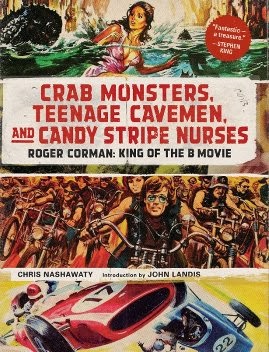
Crab Monsters, Teenage Cavemen and Candy Stripe Nurses - Roger Corman: King of the B Movie

Now that's a title and a half for a book.

But that's fair enough because it's a lovely book, both to look at and to read. It's lavishly illustrated with movie stills, film posters and behind the scenes photographs, all illustrating the story of a quite remarkable man.

In case you don't know, Roger Corman is a hugely prolific film-maker who produced enough films to make him practically a studio. He's the man who shot THE LITTLE SHOP OF HORRORS in two days, but also made my favourite THE MASQUE OF THE RED DEATH, which is just a gorgeous film.

This is not a critical biography of the man, though. The story is told in interview snippets from so many people that worked with (and for, let's be honest) Roger Corman and other movie luminaries. John Landis, Jack Nicholson, Joe Dante, Jonathan Demme, James Cameron and many more all put in their penny's worth.

And pennies seems to have been Corman's ethos. Pay as little as you can get away with and make a profit on everything that you put out. Some of the films were outright exploitative rubbish, but others were bona fide masterpieces.

If only through the people whose careers he helped to kickstart, Roger Corman has been a huge influence on the movie industry and this bright, cheerful and fun read seems just the right way to celebrate him.

100 Science Fiction Films from the BFI

When it comes to movies, the British Film Institute knows a thing or two, so when they choose to produce a book giving you the top 100 entries into a genre then you'd expect to sit up and take notice.

As a result of those expectations, 100 Science Fiction Films by Barry Keith Grant is something of a puzzle.

Now, don't get me wrong - the author knows his science fiction films. Whilst all the usual suspects are there (Metropolis, Blade Runner, Star Wars) there are a few less obvious entries. Nobody could argue with La Jetee, for example, but it's a bit on less well-known side as are Born In Flames and Tribulation 99: Alien Anomalies Under America (what do you mean, everyone has heard of that one?).

No, the reason for puzzlement is the form of the book. Nobody would expect a book from the BFI to be a vapid picture gallery, but the assessment that goes with each film proves to be mainly a precis of the storyline (and yes, spoilers ahoy!) with only a small amount of time spent on why the film is notable. Each film only gets two pages and that's reduced to only a page and a half when you take into account the single image that goes with it. This really doesn't give enough space for the author to go into any great depth.

So, here's the rub - who is this book for? True, if you are a newcomer taking on the genre for the first time, then this might be the book to guide you on your way, but there are plenty of 'best of' lists online. For the the experienced sci-fi moviegoer, there really isn't enough here to make it even a worthwhile gift from a loved one.

Monday, 15 July 2013

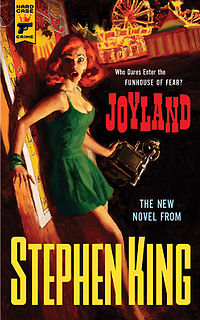
JOYLAND by Stephen King


Stephen King and I have had a bit of a falling out in recent times. UNDER THE DOME was only intermittently impressive (and what was with that ending, man?) whilst the Kennedy assassination doorstop tome is still holding open the conservatory door to allow the air in, still not finished.

JOYLAND, though, changed all that. Gone is the huge, suitcase space guzzling and self-indulgence epic and in its place is a small, spare and utterly captivating paperback. It's produced by Hard Case Crime and is only available as a paperback with a cover that deliberately recalls the pulp noir books of yesteryear.

Speaking of yesteryear, it's a recollection, a story told in flashback of a young and callow youth who spends a summer working in a beachfront amusement park and finds the man he will eventually become. Yes, King is back in full-on nostalgia mode and whilst the flashback structure inevitably robs the big climax of its necessary tension (we know he won't be killed you see, since he's already spoken of what has happened since), it allows him to wallow in what is a very lightweight coming of age tale.

It's a Hard Case Crime book, and there is a series of unsolved murders in there, but that is almost irrelevant to the story, only coming seriously into play in the last fifth. There are other King tropes in there as well such as the kid with the psychic ability (yes, King's next book will be a return visist to Danny Torrance of THE SHINING), a trapped ghostly spirit and an overbearing parent who seems all powerful and happens to be heavily religious to boot. All of these, though, are again in the background and not really the main thrust of the book at all.

JOYLAND is the tale of a boy becoming a man and not a lot more. There's a SUMMER OF '42 vibe going on that is a bit obvious, but that's OK. Doing something old isn't a crime as long as you do it well and King has done this very, very well.

In fact, the reader is welcomed into the story of young Dev, lovelorn hero of the piece with an ease that makes me hate the author. Either it really is this easy for him to throw out such a great piece of storytelling (in which case I hate him for being so talented) or he is so talented that he can make it seem so easy (in which case I hate him). This may be a little thing he churned out in his lunch hour between epic doorstops, but it has an emotional resonance that has been missing from his work of late. In fact, he manages to wring so much emotion out of two people on a beach with a kite in the final scene that I defy anyone with a heart not to tearing up.

The difference here is that King seems to have found something to interest him. Instead of recycling things he's done far too many times already, he's discovered a new world - the world of the carnival. He makes much of the language in his introduction and postscript and it is clear that is part of what attracted him to this tale. Joyland is what this book is about, not the things that happen there. It's fired him up and this book is result.

JOYLAND is not without its flaws, but it doesn't have a single flaw of any significance at all. It's a quick read, an easy read and a satisfying read. What more could you ask for?

Stephen King and I are mates again.

Sunday, 30 June 2013

Unique But Similar: The Prisoner Compared by Andrew K Shenton

Much has been written on the subject of THE PRISONER, Patrick McGoohan's elliptical, surreal cult fantasy show first broadcast in 1967-8. Much of that can be boiled down to the fact that there was nothing like it ever before and there has been nothing like it since.

That, though, is apparently a fallacy, as this book by Andrew K Shenton sets out to demonstrate.

Taking the major themes of the this landmark show, Dr Shenton shows how they have been used in other shows such as DOCTOR WHO, BLAKE'S SEVEN, UFO, JOE 90, CHILDREN OF THE STONES, THE OMEGA FACTOR and others either before or since, rustling up an impressive array of references from other commentators on the show and the genre in general to back him up.

There is always room for another book about THE PRISONER, especially by such a scholar as Dr Shenton, but I am hard-pressed to see who this particular book is aimed it. It reads like a textbook and might be immensely useful for anyone studying a course in comparable Prisonerology (assuming there is such a thing), and Prisoner completists will, of course, want to see what he has to say, but it's hardly the most entertaining presentation for someone wanting a little light reading.

You also have to question the subject matter. It's true that the themes of THE PRISONER have cropped up elsewhere, not least since they first appeared in the show, but every influential show is going to leave a legacy. An informed examination of that legacy would be interesting, to be sure, but that doesn't seem to be what Dr Shenton is trying to say. What he is trying to do is to challenge the popular perception of THE PRISONER as something quite unique.

The success of that will depend on whether you agree with him or not, but having some chapters devoted to a single episode of another show does weaken his case. I mean one single episode of THE CHAMPIONS sharing some ideas doesn't exactly bring down the walls of the case for THE PRISONER 's reputation.

If you want to see what the talking points are then head over to Amazon.co.uk , Amazon.com, or all good bookstores.

Sunday, 23 June 2013

Bill Dare's Wins - or rather doesn't - with Brian Gulliver's Travels

We have it on good authority that Brian Gulliver's Travels is a very funny radio series. Something has gone seriously wrong in the translation from show to book then as the one thing that is missing from this is the funny.

Brian Gulliver is a travel writer (did a bit of telly apparently) who has gone missing for some time. Now he's back and in an asylum recovering. His daughter meets with him to write down the stories he has to tell of his crazy journey.

Swift's Gulliver's Travels is possibly the most famous satire ever, although it is probably most known now from the bastardised Jack Black film and other movie versions. The book has lasted the test of time and so if you're going to do a new version then you better have something interesting and new to tackle. The book, however goes after some very obvious targets that have been widely covered before. Celebrity culture - yep that's in here, including the obligatory reality TV sideswipe. Our obsession with health and our bodies? Yep, you can tick that box as well. Crazy religions? Well of course. These are all barn doors to be hit with a shotgun.

The main issue for me was for the main characters. Brian Gulliver is an out and out selfish git with little to no thought for anyone else and happy to go along with anything as long as his life is a comfortable one. He's not the kind the character to idolise or empathise with and his ability to apologise it all away is infuriating.

His daughter, the chronicler of his story plays the foil for him, challenging him on all of his behaviour just in case we, the reader, didn't get the point or understand the theme being discussed.

For all that, it's easy to read and moves at a pace that actually robs it of depth since none of the places that Gulliver ends up in is much described beyond the theme that is being put forward there.

On finishing the book, you won't hate it, but you won't be singing its praises either. Oh well, back to Swift.

Wednesday, 15 February 2012

Five Star Review for Stormwreck

This is a  lovely review for STORMWRECK that was just posted. Thank you to Lorraine for taking the time.
 
"5.0 out of 5 stars Be prepared..., 14 Feb 2012
By 
This review is from: Stormwreck (Kindle Edition)
Going through all of Darren Humphries books to select the one I was going to read first, I went for Stormwreck as it was the one that was most likely to appeal to me, as I like everything weird and spooky. I thought I'd familiarise myself with the writer by reading something from my favourite genre before moving on to something sci-fi or humoristic. I was even more enthusiastic at the idea of reading it as other group members who had read it and who knew my tastes in books thought it was a book for me. And boy were they right !

What really stuck me with this book, is how it doesn't give the feeling of being "fast-paced" somehow. You would think the fact that the events happen over a few hours only (and there are quite a few things going on), all on a background of violent storm, would give the book a very rapid rhythm, but instead I found that the main feeling was that of oppressiveness, of gloom, something that makes you feel claustrophobic even though you're there, with all the characters, on a beautiful Cornish cove.

That said, you can't help but notice how the story builds up with the storm, how the evil grows, how scared the villagers become, and how more and more drawn-in you become as a reader.

This book is definitely a different experience from what I've had so far. You don't get excited as such to get to know what happens at the end, you want to get there because you want that feeling to end, that weight to lift off, you want to disperse that cloud of mystery. It could be very easy I guess to write a novel that would just state the facts, but I think the whole atmosphere thing is created with skill, and is what sets this book apart from the other horror/mystery/paranormal books I've read in my life.

It's all very hard to explain, it's really something you really need to feel for yourself ! "

Tuesday, 7 February 2012

Four star review for TO INFINITY (and maybe that's far enough)

This review was posted earlier for TO INFINITY (and maybe that's far enough):

"4.0 out of 5 stars Nice to see Science fiction can still be fun., 7 Feb 2012
By 


This review is from: To Infinity (and maybe that's far enough) (Kindle Edition)
I'd been hearing good things about Darren Humphries work for some time now and, on that basis, decided to give one of his books a spin. I've always been a science fiction fan, as my groaning bookshelves will attest, so this title came as the ideal starting point.

Mr Humphries has written this book with a Douglas Adams / Terry Pratchett voice. In that respect it has succeeded very well. The interplay between the characters is sharp and entertaining at every point. The story moves along well and there is plenty of enjoyable dialogue.

For the most part I really enjoyed this book, but, and there is a but, something happened to the end. Everything was going wonderfully until it got to 97%. I think the problem with this book is that the enemy is too good. There is a fine line between the hero being cornered and being able to fight his way out and the same hero being painted into a corner. I felt this was the case with this book, where the author had succeeded with the painting, thrown away the brush and decided to have the wall demolished from the other side by the next door neighbour.

I know this is going to sound odd, but don't let the ending stop you reading this book, it really is a treat. There were times when I cursed the end of my lunch break as I was enjoying myself so much. On a number of occasions, I was howling out loud with laughter and annoying my colleagues by insisting on reading out sections of dialogue.

On that basis, I'm going to have to knock off a star for the ending, otherwise it would have got a perfect score. If you are a Douglas Adams or Terry Pratchett fan, you'll feel very at home with this Darren Humphries book and enjoy it immensely."

That's a detailed review, so thanks for taking the time to review it.

Monday, 6 February 2012

Five Star Review for The Man From U.N.D.E.A.D. - The Curious Case Of The Kidnapped Chemist


The first of the Man From U.N.D.E.A.D books - The Man From U.N.D.E.A.D - The Curious Case Of The Kidnapped Chemist received this nice review on Amazon.co.uk recently:


"This review is from: The Man From U.N.D.E.A.D. - The Curious Case Of The Kidnapped Chemist (Kindle Edition)
I absolutely loved this read. I was engrossed from the moment I started reading it and had to find a day where I could sit and just read so as to find out what happens!
I loved Ward's character and his humour. There was, for me, a lot of laugh out loud moments entwined with action and suspense, which kept me guessing as to who was behind all of the goings on!
I am looking forward to the next in the series and for reading more offerings from Darren Humphries.

by emzibah"

So thanks very to emzibah for taking the time to say that they liked it.

Monday, 23 January 2012

2nd five star review for Man From U.N.D.E.A.D.- Zombie Apocalypse Now

The following review was posted on Amazon for my first sequel:

"5.0 out of 5 stars TRUST me! This is a great book, 22 Jan 2012
By 
Walrus
 
This review is from: The Man From U.N.D.E.A.D. - Zombie Apocalypse Now (Kindle Edition)
A smile from start to finish and laugh at loud funny in places too.
As i said about the first book in the series- "The Man From U.N.D.E.A.D. - The Curious Case Of The Kidnapped Chemist"-If you enjoy well written,fast paced,amusing,tongue-in-cheek urban fantasy you are in for a real treat.

This book is even better;tighter written,and even better told.

Truly excelled!.More please "

Saturday, 21 January 2012

New Five Star Review for STORMWRECK

I received this rather remarkable review whilst away. It's rather more erudite than I would suggest the book is!


"5.0 out of 5 stars Spooktastic!, 22 Dec 2011
ByJenny Shaw
The essence of horror is lack of control. True horror shows us that our safe, secure little world over which we have power and in which events are predictable - or at least logical - is nothing but a comforting fairy-tale. It harks back to some long-forgotten race memory in which life could be snuffed out in an instant in a world that did not always make sense.

So what better setting for a horror story than an isolated community in the teeth of a massive and potentially deadly story. Throw in a long forgotten secret, give early indications that Supernatural is Permitted and, for good measure, cut the cast of characters off from the rest of civilisation.

It's an excellent set-up and in Darren Humphries' masterly hands becomes a highly compelling and satisfying read. As a narrator he is authoritative but never obtrusive, his characters are rounded and sympathetic and the whole thing trips along with an ease that will have you reading all night."


Wow, who'd have thought I'd ever get the phrase 'masterly hands' used in a review of my work? Not me that's for sure.